You can master Korea's procurement regulations and still lose the deal in the first thirty minutes of a meeting. Not because anyone was rude, and not because your product fell short. You lose it in increments too small to notice: a seating choice that scrambles your host's protocol, key points delivered to the fluent English speaker while the silent decision-maker watches, a pause you fill with a discount.
There is no shortage of material on what to do in Korea's defense market — the tenders, the registration requirements, the market sizing. What the literature does not teach is how the table behaves. That behavioral layer decides outcomes long before price does. I negotiate at these tables, usually on the Korean side of them, and I have watched capable foreign teams make the same dozen errors so reliably that the errors themselves form a curriculum. This piece maps the first three.
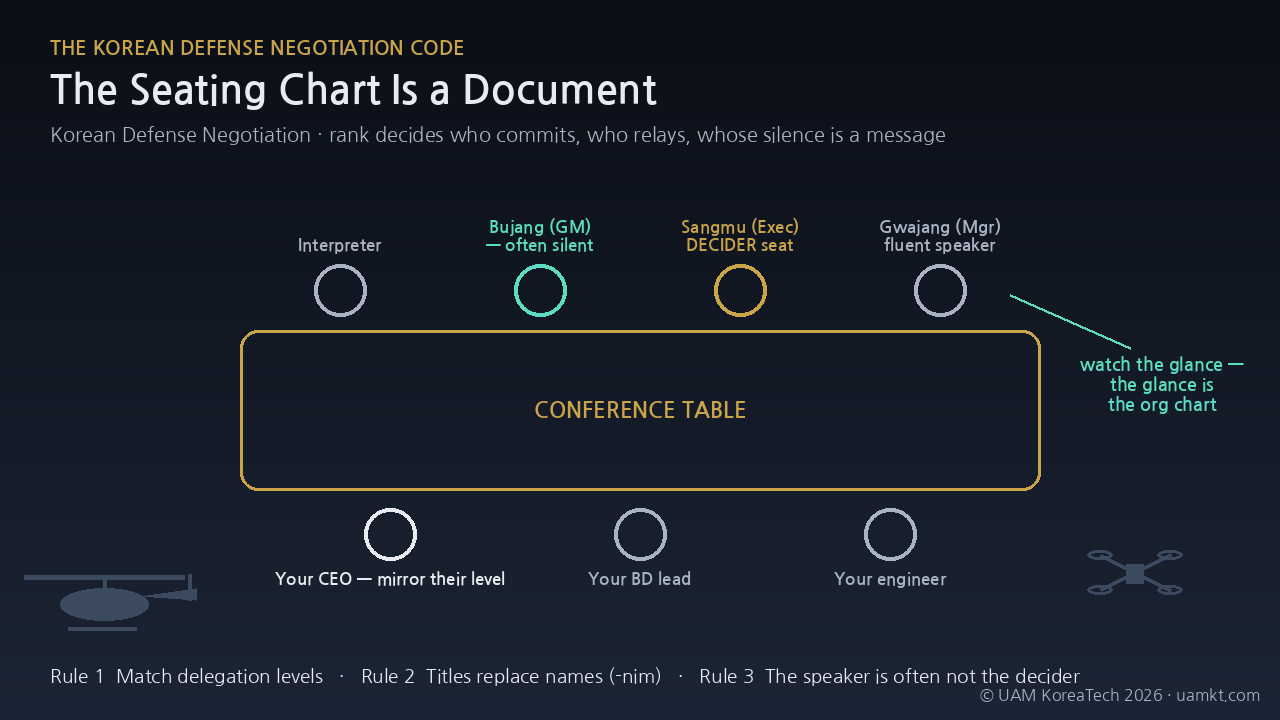
Error 1 — Reading the talker, missing the decider
Before a single slide is shown, three decisions have already been made on the other side of the table: who attends, where each person sits, and who will speak. Korea scores meaningfully higher on power distance than the US or Germany (L2 — Hofstede's comparative framework), and in the defense sector two amplifiers make rank information load-bearing: a large share of the people at the table have served as officers, and a Korean defense SME lives inside a vertical ecosystem — agency above, prime above — whose people are trained daily in managing upward (L3, field observation).
The practical consequence: in many meetings the most fluent English speaker — frequently a junior manager — carries the conversation while the senior listens. Visiting teams anchor on the talker and ignore the silent bujang by the wall. Watch instead where the speaker's eyes go before answering anything substantive. The glance is the org chart.
Error 2 — Hearing "yes" in what was attention
Korea is a textbook high-context communication environment; the United States is the world's most low-context one (L2 — Hall, Meyer). Nodding and "네, 네" track attention, not assent. Assent looks like specifics: dates, names, numbers, a request for your documents in editable format.
And refusal rarely arrives as a sentence. It arrives as a sequence — what I call the Long No: a soft deferral ("we will review it internally"), then difficulty language ("it would be difficult"), then calendar fog, then, only if you force it, a formal and relationship-costly refusal. The objective is not to prevent the no; it is to detect it at stage one or two, while the proposal can still be reshaped without anyone losing face (L3, author synthesis). Teams that cannot read this sequence chase dead deals for months — and worse, they extract public refusals that close doors the quiet pass would have left open.
Error 3 — Selling to the room, not to the document
Korean organizational decisions typically travel through the gyeoljae (결재) approval system: a formal document climbs the ladder, and each signature attaches a share of permanent ownership (L1 for the system; L3 for the negotiation implications). This explains the paradox every foreign vendor reports — "they take forever to decide, then move faster than anyone." The climb is slow because every signer underwrites career risk on you. After the last stamp, execution converts instantly into ppalli- ppalli speed.
The implication most teams miss: your proposal will be judged mostly by people who will never meet you. The brilliant meeting performance does not climb the ladder; the document does — alone. Make every page survive being photocopied out of context. Give the junior assembling the approval document an editable summary and a one-page Korean abstract. Answer every question in writing within 48 hours, because an unanswered question becomes a standing objection stapled to your file.
The curriculum, in one place
These three errors — and ten more like them — are the subject of my book, The Korean Defense Negotiation Code (K-Defense Gateway, Book 1), publishing this month on Amazon. It maps the K-방산 협상코드 behavioral terrain across thirteen chapters: hierarchy and nunchi, relationship sequencing, the Long No, the gyeoljae rhythm, offset psychology, a TIQ self-assessment, and sector playbooks for drone, MRO, and rotorcraft deals.
Three disciplines run through it, and through everything we publish: patterns carry exceptions and are never verdicts on individuals; every claim is labeled by evidence level (L1 established / L2 published research / L3 professional observation); and every signal gets two readings, because the most expensive mistake in cross-cultural negotiation is a single confident reading of an ambiguous signal.
Thirty minutes is enough time to lose a deal you spent a year preparing. It is also enough time to signal that your company is the rare foreign entrant that did its homework.
Disclosure: general information and professional observation — not legal, contractual, or regulatory advice. Agencies and companies mentioned (DAPA, KOTRA, et al.) are referenced as subjects of analysis; no affiliation or endorsement is claimed. Produced with AI assistance under the author's direction and editing.