In most markets you negotiate a product. In Korea you negotiate inside a scenario that is, legally and emotionally, still live. The armistice of 1953 never matured into a peace treaty, and that unfinished sentence is not a historical footnote — it is the frame in which every Korean procurement officer reads your proposal.
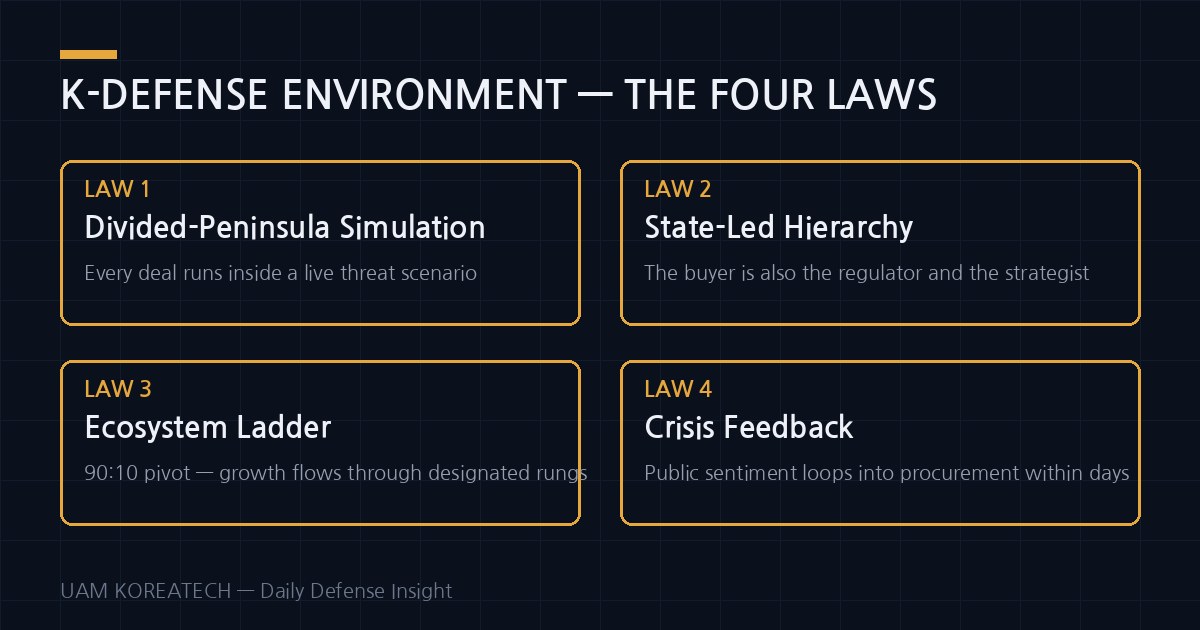
Law 1, restated as psychology
The first law of the Korean defense environment — the divided-peninsula simulation — says that every acquisition decision runs against a threat scenario that is permanently switched on. Behavioral research gives this a precise mechanism: the framing effect. Tversky and Kahneman (1981) showed that the same option, described as a loss-avoiding choice rather than a gain-seeking one, flips preferences in a majority of subjects.
A Korean evaluation board does not ask "what does this system gain us?" It asks "what do we fail to stop without it?" — a loss frame, by default, institutionalized. Foreign vendors who price and pitch in a gain frame ("capability uplift", "efficiency") are answering a question the table never asked.
What the frame re-weights
Inside the simulation frame, three variables change their exchange rate. Schedule beats price more often than spreadsheets predict, because a capability that arrives late is a scenario failure, not a discount opportunity. Demonstrated reliability beats specified performance, because the scenario punishes variance. And sovereign maintainability beats acquisition cost, because the scenario assumes interrupted supply.
None of this is irrational. It is rational behavior inside a different frame — and the frame, not the spreadsheet, is the senior negotiator.
Negotiation is not the right word
This is why we describe the Korean table with joyul (조율) — tuning, mutual adjustment — rather than negotiation in the Western, deal-closing sense. A tuning process assumes the relationship continues after the chord is struck.
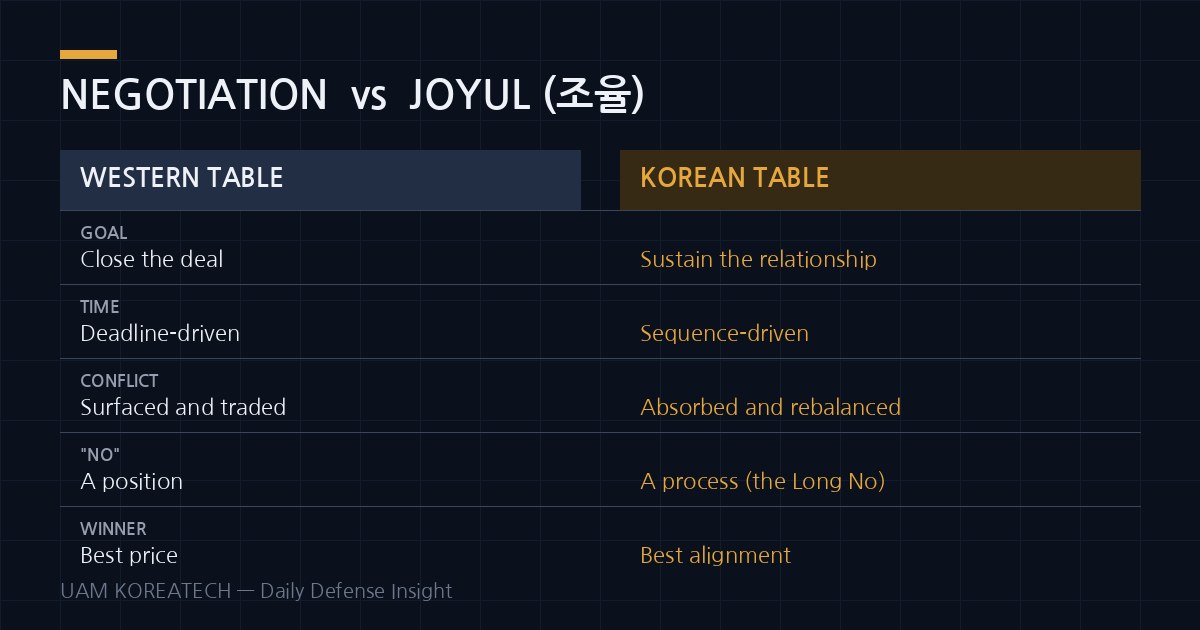
The practical read
Before your next Korean defense meeting, rewrite your value proposition once, entirely in the loss frame: what does the buyer fail to prevent, detect, or sustain without you — inside their scenario, not your market. If the rewrite feels unnatural, that distance is precisely the gap this series exists to close.
Practitioner analysis grounded in published behavioral research (Tversky & Kahneman, 1981, Science 211). Not legal advice. Part of the K-Defense Gateway series — advisory inquiries via the Consulting page.